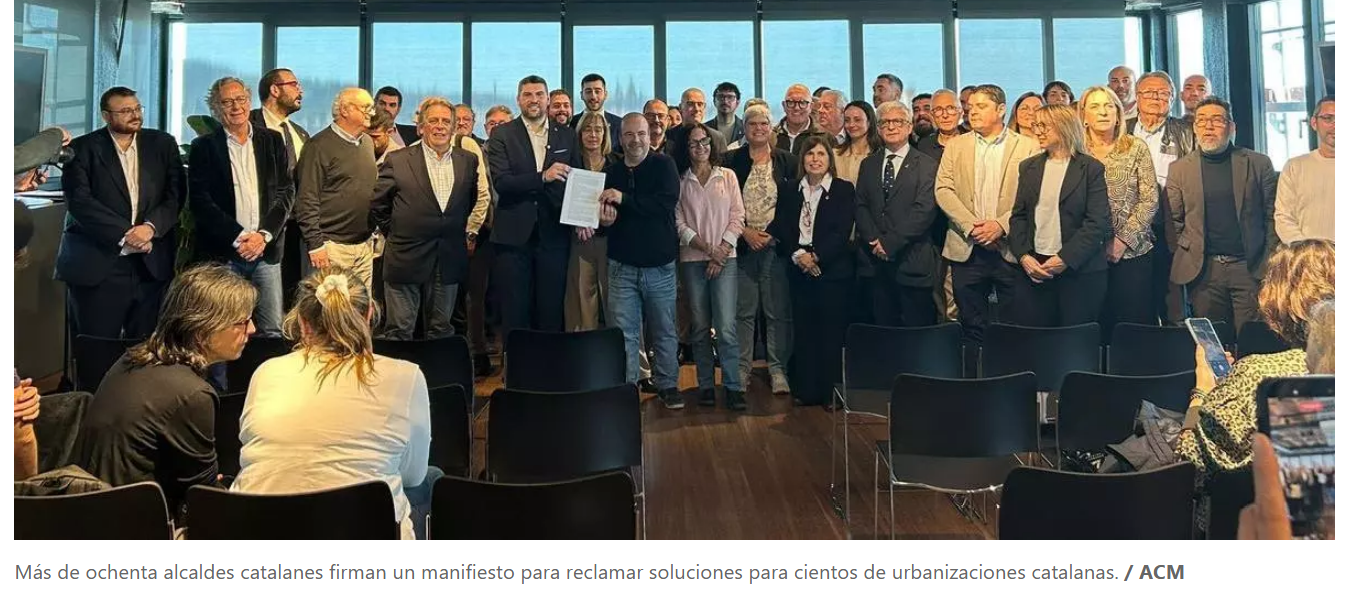
Dozens of Catalan municipalities are pushing to obtain public aid in the regularization of urbanizations. The question is what strategy Corbera wants to follow.
In politics, sometimes an image is enough to open many questions.
This week, dozens of Catalan municipalities have united to ask for institutional support that allows regularizing urbanizations without passing the entire cost on to the neighbors. A demand that directly affects many municipalities, but especially Corbera de Llobregat due to its large number of urbanizations.
The news, published by El Periódico (and which can be consulted or downloaded in PDF here), describes a significant event that should catch the attention of any neighbor living in an urbanization pending regularization.
In it appear dozens of mayors from all over Catalonia demanding solutions from the Generalitat for a problem that affects thousands of families: the high cost of urbanizing and regularizing hundreds of urbanizations spread across the territory.
The request is clear. The municipalities request public aid and a more flexible legal framework that allows facing these works—or new technical solutions—without passing the entire cost directly on to the neighbors.
It is not a minor issue. In many cases we are talking about actions that can reach figures of tens of thousands of euros per plot. That is why it is not surprising that so many mayors have decided to make a common front.
A problem that directly challenges Corbera
The demand is not foreign to Corbera de Llobregat. On the contrary.
For decades, the residential growth of the municipality has relied on numerous urbanizations that today are part of the daily reality of thousands of neighbors and that, in many cases, are still pending the completion of their urbanization or municipal reception process.
Urbanizations like Santa Maria de l'Avall know this problem well. That is why the mobilization of dozens of mayors demanding institutional support to face these costs is especially relevant for our municipality.
Different strategies
Faced with this scenario, many city councils are opting for a clear strategy: pressuring higher administrations to obtain aid and legal frameworks that allow reducing the economic impact on neighbors.
The logic is simple: if the problem affects hundreds of municipalities and thousands of families, the solution can hardly fall solely on the owners of each urbanization.
However, in Santa Maria de l'Avall the debate that has been raised so far has followed another path.
The presented project contemplates an investment close to 13 million euros, the cost of which would fall exclusively on the owners of the plots.
Without clear financing mechanisms for the most vulnerable groups and without a defined role for the city council in the bidding or execution phases, the neighbors would be exposed to assuming a very high debt and the risks inherent to a work of this magnitude.
Two ways of facing the same problem: demanding public aid... or passing the entire cost on to the neighbors.
The inevitable question
No one disputes that the regularization of urbanizations is a complex challenge. Nor that the solutions require time, institutional negotiation, and legal changes.
Precisely for this reason it is inevitable to wonder what position Corbera wants to adopt.
- Has the City Council considered joining initiatives such as the one promoted by dozens of Catalan mayors to demand public aid?
- Has it been considered to pressure higher administrations to alleviate the economic impact on the neighbors?
- Or has it been decided to opt for a model in which the entire burden of financing falls on the owners?
A double front of concern
To this lack of institutional positioning is added the concern about what happens internally.
According to several neighbors in the follow-up meetings, there is concern because, apparently, the result of the last vote is not being fully respected.
Will the majority's decision be executed—to study viable alternatives such as the case of bio-purifiers—or will there be continued insistence on a 13 million euro project that already generated an obvious rejection in the vote?
These are legitimate questions. Questions that many neighbors are beginning to ask themselves when observing this mobilization of mayors throughout Catalonia.
Because when more than eighty mayors mobilize to demand solutions for their municipalities, it is inevitable to wonder what path Corbera wants to follow. And in politics, sometimes, it is not necessary to say much.