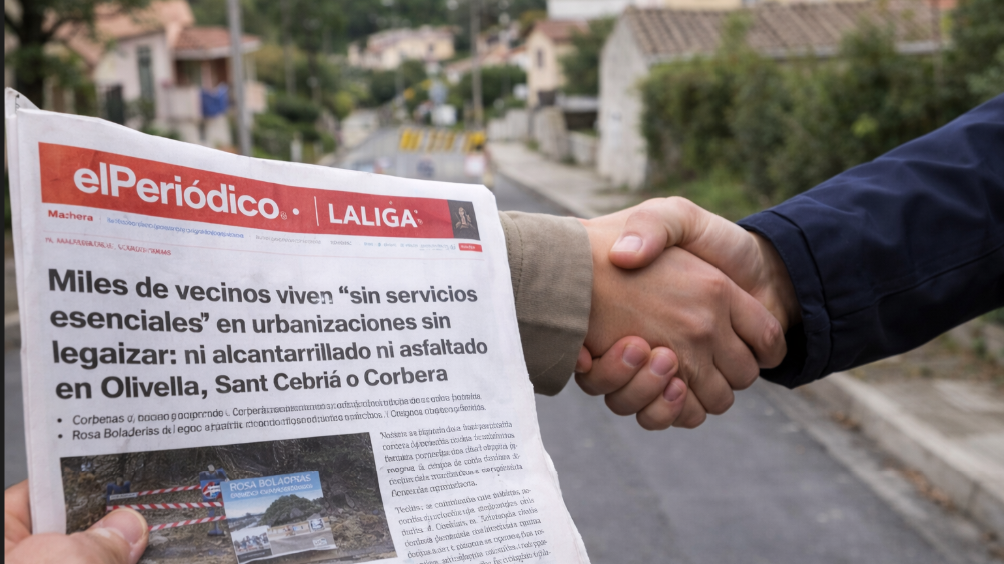
When criticisms are made, there must also be room to recognize gestures that go in the right direction. And in this case, we believe it is fair to do so.
In a recent report published by El Periódico (which you can download in PDF here), one of the great urban challenges that continue to affect numerous Catalan municipalities is addressed: the existence of urbanizations built decades ago that still have serious deficiencies in essential services such as sewage, paving, or lighting.
Among the mentioned municipalities, Corbera de Llobregat also appears, and it does so with an idea we consider important to highlight: the Corbera City Council, represented by its mayor Rosa Boladeras, publicly acknowledges the magnitude of this problem and positively values institutional support to be able to address it.
According to the article, the mayor defines this situation as a “major national challenge” and considers the Government's support to face this structural problem “great news”.
Recognizing the problem is the first step
It is not, therefore, a minor issue or an isolated case. We are talking about a reality that affects thousands of people and has dragged on for decades in many municipalities in Catalonia. And precisely for this reason, we believe it is important to recognize when a public institution clearly admits the dimension of the problem and the need to seek broader, more realistic, and fairer solutions.
From the Santa Maria de l’Avall Neighbors Group we believe that consistency requires maintaining a clear and balanced position. When we consider that certain decisions or approaches do not sufficiently benefit the neighbors, we say so. But when the City Council aligns itself with the need to seek fairer solutions of greater institutional scope, we also believe it should be recognized.
And that is exactly what we want to do today.
We find it positive that the Corbera City Council has publicly expressed that the urbanization problem requires support, regulatory changes, and a national perspective. That position goes in the direction of what many neighbors have been demanding for a long time: that an issue of this magnitude cannot be resolved by unloading all the economic weight onto the affected families.
That same concern was already present in the two articles we previously published about Santa Maria de l’Avall, which raised legitimate questions about the strategy followed so far and the need to explore more viable alternatives for neighbors.
Santa Maria de l’Avall still needs answers
This institutional recognition, however, does not eliminate the concern that still exists among many neighbors of Santa Maria de l’Avall. Our case continues to need clarity, dialogue, and a strategy that takes into account both the technical viability and the economic reality of those who live here.
In recent weeks, a very sensitive debate has arisen in our urbanization about the future of the urbanization project and the cost that could fall on the owners. Precisely for this reason, this new public positioning of the City Council is even more relevant.
If the council itself recognizes that we are facing a structural problem, broad and shared with many other municipalities, then the reasonable thing is for this recognition to also translate into more information, more dialogue, and more willingness to explore viable solutions for Santa Maria de l’Avall.
- Solutions that take into account the economic reality of the neighbors.
- Solutions that take advantage of possible regulatory changes and institutional support.
- Solutions that do not start from the idea that the entire burden must fall exclusively on the owners.
A step that deserves to be valued
Sometimes, in contexts of tension or disagreement, there is a risk of turning any institutional gesture into a motive for confrontation. We believe this should not be the case.
We believe that publicly recognizing the urbanization problem and defending the need for fairer solutions for neighbors is an important step. And for this reason, we consider it fair to thank the Corbera City Council, through its mayor Rosa Boladeras, for having contributed to placing this debate where it belongs: in the realm of collective solutions and not just individual burdens.
Hopefully, this recognition will also serve to open a more constructive stage of dialogue about the future of Santa Maria de l’Avall.
And because when we talk about the future of our urbanizations, it is not about winning a debate, but about finding reasonable ways to move forward without leaving anyone behind.