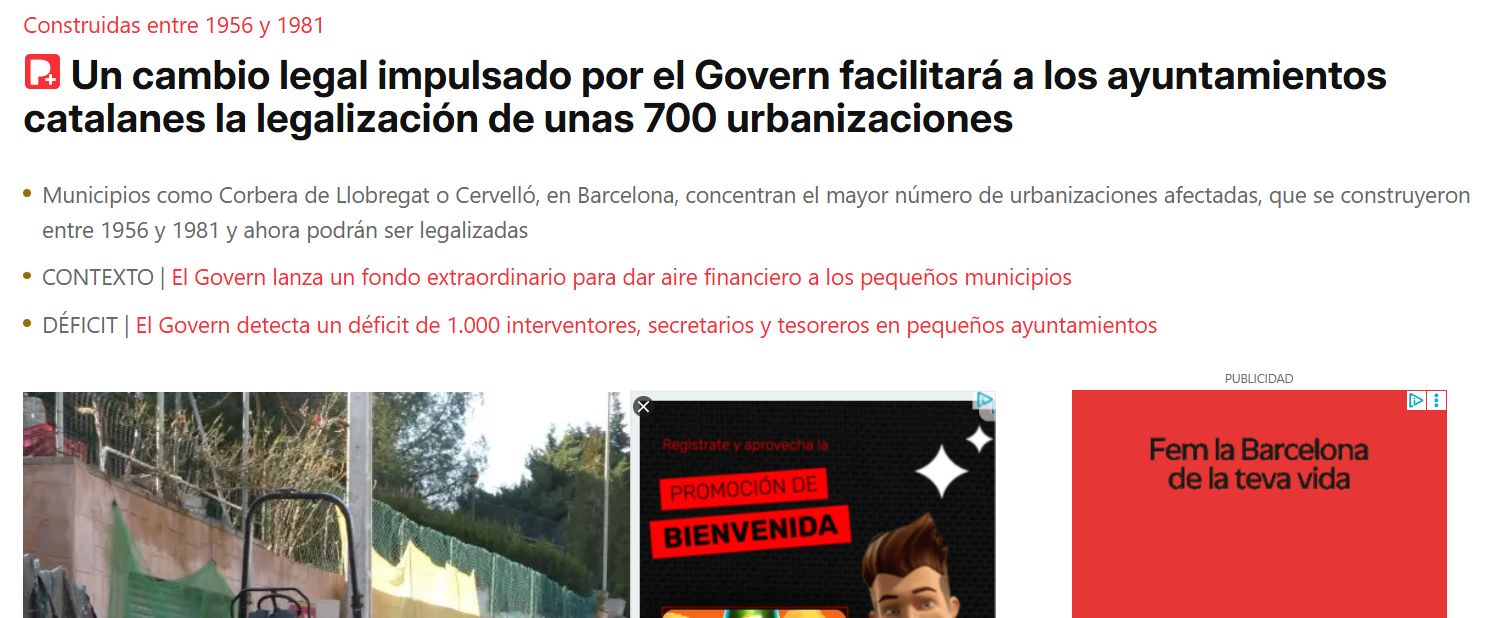
A regulatory reform in preparation could facilitate the regularization of urbanizations like Santa Maria de l'Avall. The question is why this possible change was not mentioned during the neighborhood assembly.
Sometimes the most important news isn't in what is said... but in what nobody mentions.
The Generalitat has announced that it is working on a legal change that could facilitate the regularization of hundreds of urbanizations in Catalonia, many of them with characteristics very similar to Santa Maria de l'Avall.
The news, published by El Periódico (and which can be consulted or downloaded in PDF here), explains that the Government is preparing a regulatory modification aimed at making some of the requirements that were previously demanded of city councils to legalize urbanizations built decades ago more flexible.
In simple terms: the Generalitat itself recognizes that it makes no sense to demand the same urban model for an urbanization surrounded by forest as for a neighborhood in the center of Barcelona. The goal of the reform is to open the door to more realistic, sustainable, and economically affordable solutions.
For the neighbors of Santa Maria de l'Avall, this news is of obvious importance. Because while this new legal framework was taking shape, an urbanization project of nearly 13 million euros was being debated here, the cost of which would fall exclusively on the owners.
And that raises an inevitable question.
An uncomfortable question
Legislative reforms of this type do not appear overnight. They are usually the result of months of conversations between administrations and municipalities affected by the same problem.
In this context, it is reasonable to wonder if the Corbera City Council was aware that a regulatory reform was being worked on that sought precisely to facilitate the regularization of urbanizations like ours.
During the recent extraordinary assembly, held in a climate of enormous concern among the neighbors about the economic impact of the 13 million project, this possible legal change was not mentioned.
- Was it considered to inform the neighbors that the regional regulations could be modified in the coming months?
- Was the possibility of waiting to know the new legal framework before advancing a project of such economic magnitude considered?
These are legitimate questions that many neighbors are beginning to ask themselves today.
A new scenario
If the reform announced by the Generalitat materializes, it could open the door to urban solutions more adapted to the reality of urbanizations like Santa Maria de l'Avall.
That would include less costly and technically more appropriate models for the natural environment, something that many Catalan municipalities have been demanding for a long time. The economic difference between a rigid urban model and an adapted one can mean millions of euros for the neighbors.
In this context, it is difficult to understand why a 13 million euro project that already generated a majority rejection among the neighbors is still being proposed.
Transparency and responsibility
Faced with this new scenario, the reasonable thing would be to open a stage of transparency and reflection.
The neighbors deserve to know what information the City Council had about this possible legal reform and how it can really affect the future of our urbanization.
It would also be logical to paralyze any progress on the current project until the new regulatory framework is clearly known. Because when the economic future of hundreds of families is at stake, decisions should not be made in a hurry or without all the available information.
Santa Maria de l'Avall deserves better than that.
"And when millions of euros are at stake, information should never arrive late.
That is why the question now remains on the table: what strategy does the Corbera City Council plan to follow in this new legal scenario?"